Search This Blog

Friday, April 23, 2010

Insight on Disability count in Census of India: Javed Abidi

By Shweta Chooramani (schooramani@sightsavers.org)

One of the leaders for advocating rights of persons with disability, an Ashoka fellow, recepient of 'Super Idol' lifetime achievement award by I.B.N.7. for contribution in disability sector, Mr Javed Abidi, Honorary Director of National Centre for Promotion of Employment for Disabled People (N.C.P.E.D.P.) visited Sightsavers India Regional office, Mumbai on 23rd April, 2010. He met Sightsavers team and updated them about the efforts taken by NCPEDP to ensure that the ‘Question on Disability’ is included and asked properly in census 2011.

Mr Javed Abidi - Honorary Director (NCPEDP)

History of Census in India

The history of census in India dates back in 1872 when it used to conduct in non-synchronous way. With a history of more than 130 years, this massive exercise has been bringing out a reliable wealth of statistics every 10 years without fail. He informed that the questions on disability were asked when the census started until 1931. It was after independence that question on disability was dropped as the statistics had the direct influence on the resource allocation.


Meeting with Sightsavers Team at Mumbai

Inclusion of Disability in Census 2001

Mr Abidi shared his experience of including disability in census 2001. In 1995 passing of PWD Act led to the movement of collecting numbers for appropriate allocation of funds through the government. In 1999, Mr Abidi wrote a letter to the then commissioner of census to include question on disability. The reply came ironically around December during International Day for Persons with Disability that "we are happy to share with you that the question on disability will not be included in census 2001".

This was enough to ignite the movement at national level with more passion across the country. This was followed by six months of pitched battle through press conferences, press meets, dharnas, rallies etc. under the flagship of NCPEDP. Mr Abidi lamented that it took 6 months for the country to be convinced for a question on disability. At last, question was included in census 2001 with four categories and results showed 2.1% of Indian population had disability.

"The official figure for the disabled population of India is 1.9% (Source: NSSO Survey 1991) ! If we compare it with percentage of people with disabilities in other Asian Countries - China 5%, Pakistan 4.9%, Phillipines 4.4%, Nepal 5.0%, we can either pat our backs for literally having eradicated disability out of India or we can pinch ourselves in order to wake up and face the real truth. "

-Quote by NCPEDP cited in Disability World (web-zine on international disability news, Jan-Feb 2001)

Progress So Far for Census 2011

The coming census will be one of its kind in the world enumerating 1.2 billion population of India, engaging 2.5 million people to carry out this massive excercise to create a biometric national database. In this census, every person aged over 15 years will be photographed and fingerprinted to create the database.

To further fine tune the disability count in the commencing census , this year NCPEDP organized a roundtable consultation in New Delhi on 5th and 6th March in presence of Dr. C Chandramouli, the Registrar and Census Commissioner of India. From Sightsavers, Mr Ketan Kothari (Programme Officer, South India Area) participated in the consultation. In this consultation, the group constituting the representative of disability sector were suggested to draft appropriate questions on disability to be included in the census questionnaire by Dr Chandramouli. It was in this meeting, NCPEDP was asked to prepare training material in the form of guide book and to participate in the training of enumerators. About 100 persons from 21 states participated in the meeting.

Mr Abidi further shared with the group that, they are planning to organize phase wise training for train enumerators at all the levels starting from 90 national trainers (master trainers) who will train 270 zonal trainers. He insisted that order of question to be asked should also be changed as in last census, the disability question was at number 15. To improve the data collection, the responsibility lies with the disabled person and their family members also. To address this an awareness campaign will be launched to sensitize people before census.

The meeting concluded with high hopes of getting the numbers right.


Ms Elizabeth Kurian- Regional Director (Sightsavers) falicitating Mr Javed Abidi with book on the life of Sightsavers founder Sir John Wilson.

*Photo courtesy: Bhavana Pande

Thursday, April 22, 2010

From the desk of VISION 2020 India

By Dr Rajesh Noah, Executive Director
VISION 2020 : India

1. A roadmap for Advocacy for eye health will be prepared by about 45 participants. We will meet over a period of two days at Delhi on May 13th and 14th. This workshop will be led by Mr RD Thulasiraj (LAICO, AECS), along with Mr Mathew Cherian (HelpAge India). We have made an audio-presentation and preworkshop reading materials available at http://www.vision2020india.org/homepage.asp

2. We have recently concluded our 26th Board Meeting at Nagpur, hosted by Dr Vinay Nangia (Suraj Eye Institute). They are also doing exciting work on Diabetes (in the Central India Eye and Medical Study). The ORBIS Funded paediatric unit was inaugurated by Mr NP Pandya (HV Desai Eye Hospital). The 26th Board Meeting was a milestone Board Meeting in our history as the Board has initiated the following practice to more effectively engage our member institutions, appreciate their work and also enhance and build up a technical body of knowledge through conducting Continuing Medical Education (CME) in Community Ophthalmology. We had sharing of experiences by Dr GV Rao, Dr Sara Varughese, Dr Vikas Mahatme, Dr RD Ravindran, Dr Taraprasad Das, Mr G Ganesh. In future, we will continue to follow this pattern, i.e., (1) An affirmative, appreciative visit to our member institutions, (2) Board Meeting, and (3) Scientific Program (CME). We also have another institution as our member – Evista Eye Care Centre, a ISO & NABH certified organization led by Dr Sanjay Jaiswal.

Van supported by Sightsavers South India Area at Suraj Eye Institute , Nagpur

3. The Board also agreed to assist NPCB, GOI in developing a strategy for North East India; a combined team will be visiting Assam and Meghalaya from 25th – 30th April. Phase II will consist of a Stakeholders Workshop to identify the needs and gaps and see how various stakeholders can work with NPCB, GOI and States to plug in these gaps. Exciting and challenging opportunity. We have had immediate positive responses from Sightsavers International, LCIF, CBM, Light For the World, Operation Eyesight International. Dr Jennifer Basaiwmoit has agreed to become our point-person for North East.

4. The Board decided to split up the East Zone and create another zone for these 8 states in North East India. We also decided to split up the North Zone to create a Central Zone – Dr BK Jain has volunteered to help us out. We now have the following representatives / point persons: North Zone (Ms Tanuja Joshi), South Zone (Ms K Mani Mala), West Zone (Dr (Col) M Deshpande, East Zone (Mr Paritosh Das) and Central Zone (Dr BK Jain).

Thursday, April 15, 2010

Namma Bengaluru Award - 2010 to Sankara Eye Hospital, Bengaluru

By Dr Kaushik Murali (murali.kaushik@gmail.com)
Director Nanna Kannu Project -Sankara Eye Hospital, Bengaluru.

Glad to Share with you that Sankara Eye Hospital, Bengaluru was conferred with the ,"Namma Bengaluru Award", by His Excellency the Governor of Karnataka, Shri H. R. Bharadwaj & Honourable Chief Minister of Karnataka, Shri B. S. Yeddyurappa along with Member of Parliament and Chairman of the Jury of Namma Bengaluru Awards, Shri Rajeev Chandrasekhar, on February 27th, 2010 at Bangalore Palace Grounds over a glittering ceremony.

An initiative by Member of Parliament and Convener of ABIDe - Mr. Rajeev Chandrasekhar, Namma Bengaluru Awards was launched with the vision to inculcate a sense of optimism and interest in the minds of the common man and bring to the limelight ordinary citizens & institutions for their extraordinary contributions, to Bengaluru'ss developments.

Sankara was recognised for its Vision 20/20 by 2020 which hopes to establish one such eye care institution across teh country and reach out to 1 million rurual poor. In addition the Community activities through the "Gift of Vision - Rural Outreach Eye Care Programme', and the "Nanna Kannu - Comprehensive eye care programme for children" supported by Sightsavers (Kiawah Trust) lauded for Community service , Social responsibility and for the programme actively collaborating with city agencies.

The award was received by Dr Y Umesh, Chief Medical Officer, Sankara Eye Hospital Bengaluru on right side. Mr Balasuramaniam (on left), Director and Mentor along with Ms Nikki Rai , Programme Manager Nanna Kannu .


Friday, April 2, 2010

Glimpse of IPOD Meeting: 22 -26 March, 2010

Venue: The Retreat Hotel, Madh Island (Mumbai)

Dr Caroline Harper (Chief Executive Officer, Sightsavers) addressing the participants.
Guest speaker Dr Ashok Dyalchand (Director, Institute of Health Management, Pachod) being facilitated by Ms Elizabeth Kurian (Regional Director, Sightsavers India)


The Organizers

Left to Right: Ms Ilda Fernandes and Ms Mariamma Jose

Ms Emily Sajan and Mr Pankaj Vishwakarma
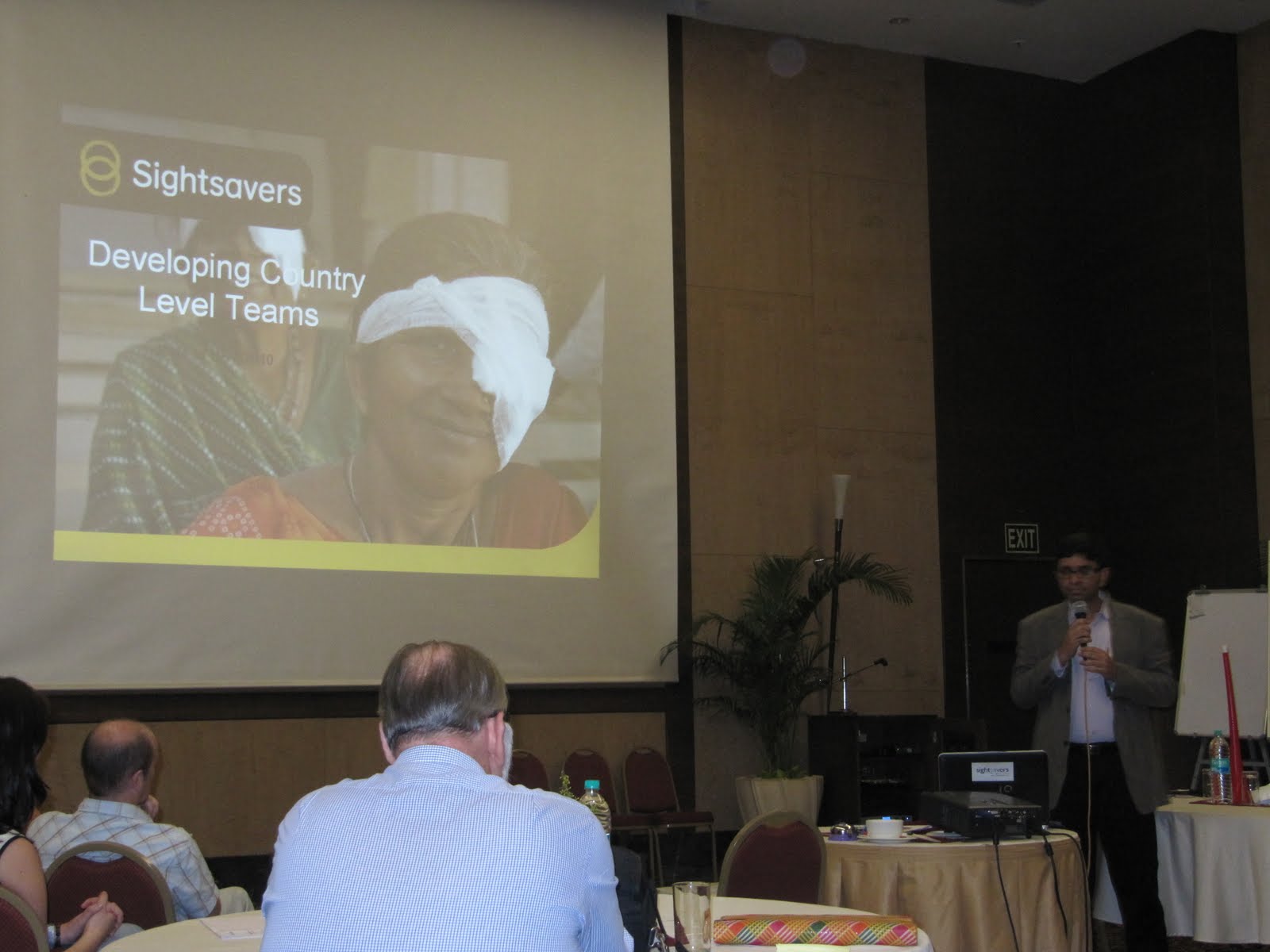

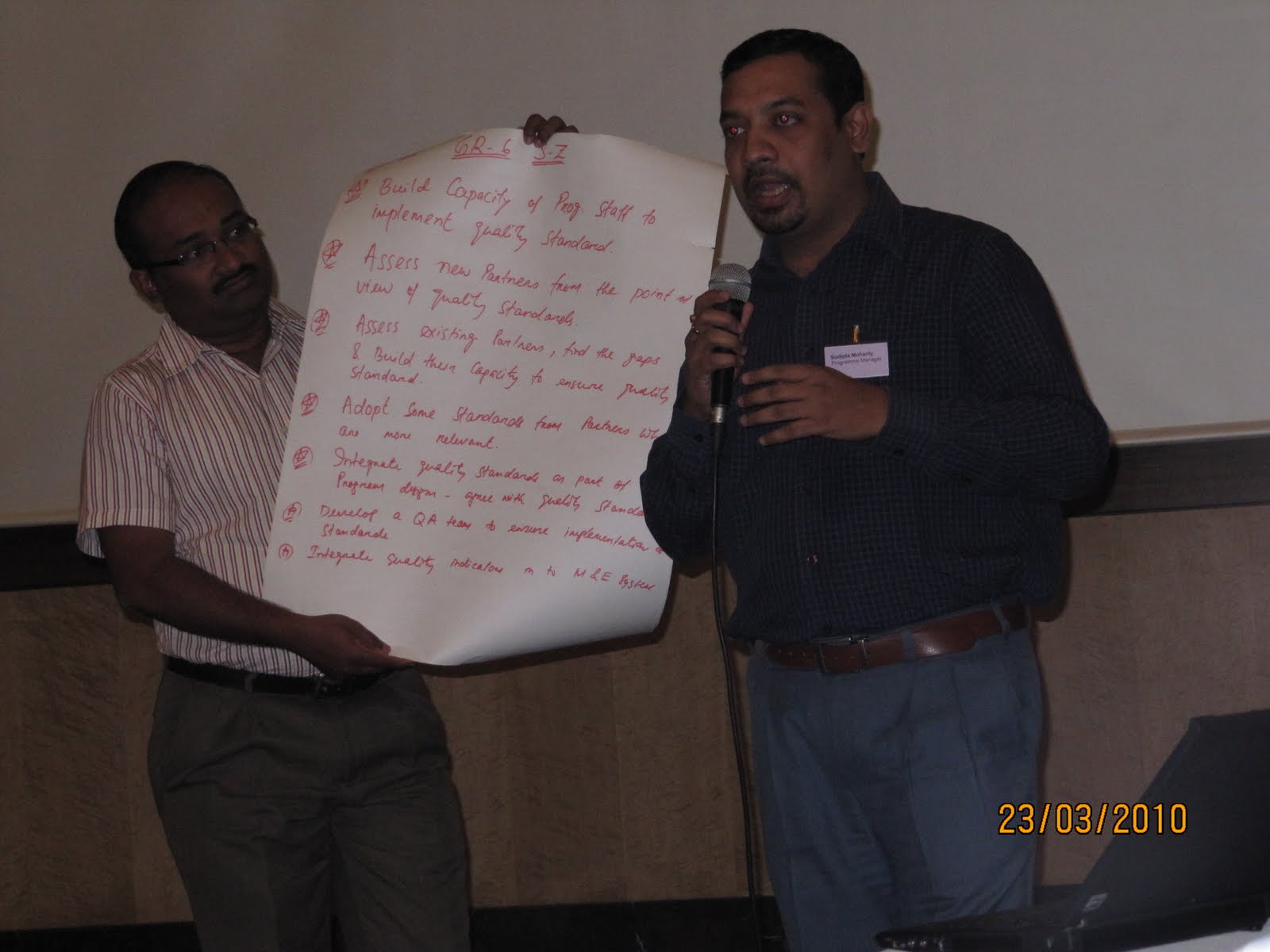
The Discourse, Groups Works and Discussions during Meeting

Dr Sandeep Kulsheshtra (India Regional HRD Manager)

Sabitra Kundu (Programme Manager, South India) and Sudipta Mohanty (Programme Manager, North India) during a presentation.

Left to Right: Joseph Musanje (Country Director, Gambia) and Prasannakumar (Area Director, North East India Area Office) doing a role play.

Posters Gallery

India Region Poster highlighting Strategic Themes

Appealing colors and content of South India Area Office.

Mumbai Eyecare Campaign Poster

The gender component illustrated in North India Area Poster was attractive.

The Barbeque Evening !
Award for best dancing : Abraham and Thoko

So who burned the dance floor !

Bhavana and Harshada on cloud 9 !

Revisiting memories !

Thursday, April 1, 2010

Social Inclusion Workshop for India and ECSA : 28th to 30th March, 2010

By Shweta Chooramani


The social inclusion workshop was primarily facilitated by Diane Mulligan, Praveen Kumar and Gertrude for three days at Hotel Retreat, Madh Island in Mumbai from 28th to 30th March,2010.

Day 1: 28th March, 2010


The day started with Diane's presentation on basic difference between human rights & equality. The session highlighted the fact that human rights respect the difference and empowers the person to take informed choices. It was emphasized that "Rights has to be given with dignity and not charity".

To let the participant grasp the concept of equality, she quoted an example of "Guaranteed Interview Scheme" in UK wherein all the applicants meeting the minimum eligibility criteria were called for an interview.


Following here presentation Ketan took a session on barriers faced by people with disability. There can be four types of barriers for disabled persons:

  1. Information and Communication
  2. Build Environment
  3. Insitutional
  4. Attitudes and Behaviour

To break these barrier time to time different types of models have been explored and applied rangin from traditional model where disabled persons were seen with pity to medical model where they their existence is valid only in presence of the certificate.

With time, social model evolved wherein the focus was on bringing the best out of the disabled person rather than their limitation. Then came the bio-psycho social model which was holistic as it envisages medical, pyschiatric and environmental needs of the person.

In second half of the session , Dr Sam Taraporewala shared his advocacy experience in financial access, print access, education of visually impaired and employement opportunities resepectively.


On left, Diane Mulligan from HH: Faciltator for workshop


Gertrude from West Africa Regional Office and Praveen Kumar from Noth East India Area Office: Facilitators


Ketan Kothari from South India Area Office: Took session on different models of disability and challenging attitudes and behaviours.


Day 2: 29th March, 2010

This day sessions were planned to identify gap in current approaches of CBR through group work. Discussions were driven around scalability, demonstration and twin trach approach. According to the twin track mainstreaming disability as well as initiating disabiltiy specific initiatives goes hand in hand.

George intorduced the guest speaker of the pre lunch session, Prasanna Pincha who is a member of national team leader on UNCRPD and also special rapporteur of National Human Rights Commission. His session revolved around the overview and analysis of UNCRPD.

Interesting disucussions surfaced up during this session about human rights and how the UNCRPD is being signed by a country. There are four generation of human rights. First generation human rights are those rights which can be realized immediately like civil and political rights. While, the second generation human rights are realized progressively by an individual like social, economic and cultural.


Guest speaker Prasanna Pincha welcomed by facilitators. He took a session on UNCRPD overview, its analysis, on how the UN convention can be used to enable PWDs to realize their rights.


Presentation by Prabhat Sinha, North West Area Office on WHO CBR matrix during group excercise.

India follows the dualist system of international law which signifies that an international commitment only becomes domestically operational when it is made part of a national legislation. India has both signed and ratified UNCRPD hence this international commitment requires that active steps be taken to make the rights available to persons with disabilities.

The flip sides of optional protocol as specified in UNCRPD was also discussed. According to this protocol a person with disability can seek guidance and justice from international committee if their voice is unheard in their country. While UK is the signatory of optional protocol, India has not signed it yet.

After the lunch session, participants were divided in group to work on linking the WHO CBR matrix with programmes supported by Sightsavers.

Day 3: 30th March, 2010

The concluding day area/region wise groups worked on stakeholder analysis for implementing UNCRPD.
Group work in India team for presentation on action plan within next 12 months on social inclusion.


Friday, March 26, 2010

Sightsavers Brand Launch Party

Sightsavers launched its new brand globally on 1st March, 2010. The new logo is compact, vibrant, rich in colors and clearly communicate its approach of working through collaboration by two overlapping rings.


Cake prepared for brand launch party by Pakistan Country Team

Sightsavers Merchandise


Official Wallpaper

India region aptly celebrated the launch following the eve of Holi (national holiday). Holi, also called the "Festival of Colors", is a spring festival celebrated in India. To get the splasth of colors, plan your visit to our projects accordingly. In this festival people play with Gulal (dry colors) and water.
You may have missed the party but these happy faces will ensure the spirit !
Holi and Brand Launch, India Team

Cheers ! Ireland Team

Srilankan Team's Delicacy


Kenya and East Central Africa Regional Team

Ring a ring o"roses ! Haywards Heath Team Happy Brand Party ! Pakistan Team

West Africa Regional Office Team

Tuesday, March 23, 2010

Ketan and Emily at LAICO Madurai

This year Ketan and Emily went to LAICO, Madurai for two weeks training (Eyecare Programme Manager's Course) from 8th to 20th February, 2010.


Let's see what Ketan has to say about it !


" LAICO was beyond expectations, I had gone there to know about eye care but was quite happy to get new insights into programme management. Their approaches appeared to me to be very practical and helped in creating a liking for eye care programmes.

I wanted to touch and see all the equipments but that appeared a distant dream till I made my feelings known to the faculties. They arranged the same and fulfilled my dream. Overall, LAICO experience was something that was worth my while and I have come back with a lot of learnings."


Emily will shortly share her feedback on compiling KPIs midnight amidst completing LAICO assignments and yes some photographs too !

Friday, February 5, 2010

From the desk of VISION 2020 : AIOS Conference 2010 @ Kolkata

By Dr Rajesh Noah (rajeshnoah@vision2020india.org)
Executive Director, VISION 2020


VISION 2020 India, in collaboration with the National Programme for Control of Blindness (NPCB) and the Eyebank Association of India (EBAI), put up a display of posters, literature and leaflets along with audio-video material for ophthalmologists at the recently concluded AIOC 2010. The 68th annual conference of All India Ophthalmological Society (AIOS) and the 15th Afro Asian Congress of Ophthalmology (AACO) held at Science City Centre, Kolkata from 21st to 24th , 2010.

VISION 2020 INDIA stall at the AIOC-2010 in Kolkata was a very good opportunity to ensure convergence with AIOS, NPCB, and EBAI and showcase the good work being done by NPCB and other Non-Governmental agencies through display of posters, literature and distribution of leaflets as well as audio/video materials for ophthalmologists coming to the conference from all over the country.

It provided 200 visitors to discuss about the work done by VISION 2020 INDIA, NPCB and EBAI and obtain necessary materials for use in their areas of work. The stall presented a good platform to showcase the blindness prevention efforts of the government and the NGOs. The stall was a must-see for those who wanted information on NPCB activities and materials produced by them.

Posters on Eye Donation developed by NPCB as well as EBAI drew lot of attention from the visitors. All the visitors, many of them from the Govt. hospitals, were given information brochures.

The show-stealers:
1. Revised 2009 editions of the NPCB Guidelines for SHS & DHS
2. Revised 2009 edition of the NPCB Guidelines for NGOs
3. Revised 2009 edition of Standards of Eye Banking
4. Set of 4 CDs containing Audio-video materials on Eye Donation & awareness messages on other eye diseases
5. VISION 2020 INDIA Annual Planner
6. VISION 2020 INDIA 2010 Diary and Brochure

Suggestions
Seeing this over-whelming response to NPCB materials, NPCB might want to depute their State Team to work with us. The presence of NPCB will make a huge difference and a greater impact in effective IEC. This in turn will create more awareness about the program leading to higher confidence among the stakeholders to serve without any inhibition benefiting the community.
AIOS 2011 : Ahmedabad, Gujarat
The Ophthalmic Fraternity would be pleased to feel the presence of NPCB in a bigger way in the next AIOC annual conference in Ahmedabad in 2011.

Thursday, February 4, 2010

The Case of Baby Anjali Nishad from Chhattisgarh

By Vasant Shendye (vshendye@sightsavers.org)
North India Area Office, Bhopal


Anjali Nishad is a 3 year old girl from Tora village [Simga block-Raipur district-Chhattisgarh]. When field worker from GRIHINI identified her [through Anganwadi worker] in the month of July 09, she was having tremendous pain in her left eye. Thus, she was first referred to CHC, Bhatapara. After examining her, Ophthalmologist referred her to Medical College, Raipur for further examination. It was then Anjali was diagnosed with Retinoblastoma [cancer in left eye] .

Retinoblastoma (Rb) is a rapidly developing cancer which develops in the cells of the retina, the light detecting tissue of the eye. It usually develops in early childhood, typically before the age of 5.

Retinoblastoma is rare and affects approximately 1 in 15,000 live births.

In most children with retinoblastoma, the disease affects only one eye. However, one out of three children with retinoblastoma develops cancer in both eyes. Most children are diagnosed before the age of five years old, as in the case of Anjali too. Retinoblastoma is often curable when it is diagnosed early. However, if it is not treated promptly, this cancer can spread beyond the eye to other parts of the body. This advanced form of retinoblastoma can be life-threatening. The first priority is to preserve the life of the child, then to preserve the vision and thirdly to minimize any complications or side effects of the treatment. The exact course of treatment depends on the individual case.

In case of Anjali, she underwent an operation on 8th August 2009, where her left eye ball with the tumor was completely removed [Enucleation] and her life was saved before the spread of tumour. This space will soon be replaced by an artificial eye.


Her parents have taken her for 2 subsequent follow ups and now there are no complaints.

The Driving Force: GRIHINI

GRIHINI, the CBR partner has constantly given support to her parents in terms of counseling and referral. By early identification, quick referral and by providing constant support, GRIHINI has done a comendable task.
GRIHINI is a voluntary non-profit making organization established in the year 1996 that promotes social development through community based organizations. Its is working with the theme of empowering women through livelihood, health, nutrition and education based interventions.

GRIHINI initiated a CBR and IE project with the support of Sightsavers in the year July 2008 in Simga block of Raipur district.


According to the recently concluded population based survey (2000-2001), prevalence of blindness in the state of Chhattisgarh is 1.6 % i.e. approximately 3.3 million people are blind in the state of Chhattisgarh. GRIHINI is one of the recent partners of Sightsavers in the state of Chhattisgarh.

Right to Read

By Ketan Kothari (kkothari@sightsavers.org)

South India Area Office, Mumbai

30th January is a day of great significance in the history of India. It is the death anniversary of India’s father of nation, Mahatma Gandhi and also the martyrs’ day. But this year was special for print impaired community.

Saturday afternoon in Delhi was pleasant and pregnant with hope. The International Book Fair was being inaugurated at Pragati Maidan. We had chosen this occasion to be the apt time for a major launch of “Right to Read”.

Several organizations came together and proclaimed to the world that all print impaired people all over India have the right to read all the literature the very day it was published. Their choice was no longer to be governed by organizations that converted the literature in accessible formats.

I along with Ranjish Kattady represented Sightsavers at this launch.

The afternoon began with a skit proclaiming the right in the loudest terms. After this, people were invited to present their views.


I told the audience that we must insist that we should get to read all the literature and Government should make it sure that our right to read is protected. In fact, as per Article 21 of our constitution, we have already been guaranteed this right as it enunciates right to Life with dignity.


Many blind and visually impaired people repeated this. Dr. Sam Taraporevala told the gathering that more than 550 authors and 40 publishers cutting across linguistic borders have consented to convert their literature in accessible formats.

A panel discussion took place with Sagarika Ghose, a famous TV anchor moderating it. Christopher Friend gave an overview of Global Right to Read campaign and informed the audience about the various efforts taking place across the globe to get the publishers on our side.


WIPO treaty was also mentioned. It was shocking that publishers were harping on their fear of piracy whereas there is no evidence to suggest that we are responsible for it. Javed Abidi hammered the publishers that it is sad that such simple changes require legal interventions.

It was a great afternoon.

When we parted, we were sure that we shall overcome all the hurdles and get the right that we deserve. This was one of many struggles that we may have to undertake to get what we want.