Search This Blog

Monday, May 31, 2010

Social Inculsion Workshop in West Africa : 17th to 19th May, 2010

By Praveen Kumar

pkumar@sightsavers.org

As part of my interest in the Social Inclusion Theme and need of the partners a workshop design was developed and a 3 day workshop on Social Inclusion of PWDs was conducted at Bhubneshwar in January, 2009. This workshop design was later considered as a global template for Sightsavers and thus the workshop was replicated in Bangladesh for the country office team and in Mumbai for ECSA and India region staff.

My visit to Dakar was planned with an objective of supporting Gertrude Oforiwa Fefoame (Asia- Africa Social Inclusion Advisor) in conducting a similar workshop in Dakar (Senegal), for the staff of West Africa (East and West) regions.


The three days workshop in Dakar from 17th to 19th May 2010 had about 50 participants from all departments including finance and admin of WARO East and West regions. It was organized as a part of WARO Regional Meeting. Though initially, Gertrude and I thought that the number of participants was a bit high and will be difficult to manage, to our surprise the workshop was one of the best and the most participative one which we had ever attended/conducted. It also gave me an opportunity to have a broader view of Sightsavers programmes on Social Inclusion across Africa through the discussion during the workshop.

Quoting Elizabeth Elhassan (Regional Director – WARO West ) and Benedict Hoefnegals (Regional Director – WARO East), this was one of the best regional meetings they have attended since joining Sightsavers, packed with vital learning which could be immediately linked and applied to programmes and practice.

The focus of the workshop was mainly on the twin track approach and on using the CBR matrix while planning the social inclusion programmes. Following are the action points drafted by the Regional Directors after the workshop.

Action Points:

- Country Office (CO) and Regional Office (RO) teams to review the Social Inclusion and Education sections of strategy papers to reflect learning from the training – alongside PITEC feedback on country / region strategy papers (CSP/ RSP).
- CO and RO teams to review their Project/Programme portfolio and align it with the strategic framework and Sightsavers programme approaches.
- CO and RO teams to review accompanying operational plans for Education and Social Inclusion areas of work, and submit to the regional office, Diane Mulligan & Gertrude for feedback, by the end of July. Note that all CSPs & Operational Plans should reflect the Twin – Track approach.

The visit to Senegal had also given me an opportunity to be nominated to the Guinness Book of World Records as the airlines missed my luggage during the onward as well as return journey. But it seems there are people who have missed it several times during their journey to Africa.
One learning, I would like to pass on to my colleagues who may travel to Africa is just carry one suitcase as hand baggage so that you have lesser chances of missing your checked in baggage.

Saturday, May 15, 2010

Postcards from Kenya and Tanzania

By Shweta Chooramani
schooramani@sightsavers.org
Warm smiling faces welcome you on Jomo Kenyatta Airport, Nairobi. The airport is named after their first president, also known as the founder of Kenya. A smile can do wonders while you are in Africa !

Kenya Country Office (Nairobi) in the premises of Barclays House. The building was disabled friendly. Even inside the building requisite ramps and supports were installed.

The integrated education model of ECSA region. The entire model is delivered by the government schools. ECSA support resource rooms, braille library, assistive devices and training of school teachers. Sightsavers implement this project in partnership with Ministry of Education.I visited five government education facilities namely Menengai primary school, Nakuru boy’s high school, Kilimani primary school, Makalala primary school and Kisiwandui primary school.


The braille library at Kilimary Primary School, Nairobi supported by Sightsavers through their partner ABC (Africa Braille Centre). Incidentally, ABC and Sightsavers share same office building.
Resource room for visually impaired children at Kilimary Primary School, Nairobi supported by Sightsavers. The children coming to these government schools were from low socio economic background. Education in private schools were found to be very expensive in ECSA. The project was first piloted in few district of Kenya during 1990s, results were demonstrated to government and then scaled up through integration within the govt. education system, reaching close to 700 visually impaired children.

Resource centre for visually impaired children at Menengai Primary School, Nakuru district of Kenya. The district was primarily rural, still the resource room was utilized with presence of a range of teaching and learning materials. For advocacy purpose at policy level, a research study was undertaken by KCO on the cost allocation per visually impaired children in Kenya. The study suggested, the amount allocated by the government needs to increased from current level of USD 10 per child per year to USD 25.

Resource room for deaf blind children at Kilimani Primary School, supported by Sense International. The convergence of development agencies within the government facility to avoid duplication of resources is encouraged by Ministry of Education.

Children greeting with "namaste" at Makalala Primary School, Tanzania. Though in very rural and interior part of Mufindi district the enrolment of visually impaired children was encouraging. However, the subtle message on discrimination was conveyed due to disntictive uniform ( green sweaters for PWD). To my dismay, I was told that 'Albinism' is considered as a taboo and disability in rural parts of Tanzania. This goes to the extent of killing albino children as they were believed to bring curse to the family.

This is a picture of vision centre being run at Unguja at Zanzibaar. The medical team from Sightsavers supported Mnazi Mmoja Government Hospital organize camps while the facility was constructed by the community. Sightsavers and Ministry of Health jointly implement eyecare programmes which were primarily focussed on Trachoma and Onchocerciasis.

This picture was clicked while going through country side of Nakuru district. Making public buildings accessible was pushed by KCO as one of the advocacy agenda. A circular was sent to all the public buildings based on UNCRPD to make the facilities disabled friendly within one year, else their name would be printed in newspaper under "hall of shame" ! And guess what, it was working there !

CD has a collection of songs sung by PWD selected by Sigthsavers ECSA regional office. The music is called "Taarab" as its influenced from Arabic countries which ruled most parts of East Africa for trading slaves.

At the backside of Barclay's House, there was office of Kenya Institute for the Blind (KIB)supported by government for braille books production. While going back to hotel, seen these well dressed confident gentlemen waiting to cross the road, who speaks volume about the empowerment and employement of blind persons within BPOs/DPOs.

Presenting here Sylvester Sattu, the avid lover of Indian cuisine specially chicken makhanwala at Khana Khazana restaurant, Dar-Es-Salaaam. Bhajias and samosas were the first option for snacks available anywhere anytime.


Group of Masaai, ethnic tribe of Kenya and Tanzania. On weekend, me and Mary Muturi (Programme Officer - KCO) went to Nairobil National Park safari where the group danced with the visitors before parting away. The tourism industry in Kenya is the second largest source of foreign exchange revenue after agriculture.

Zanzibar also known as "spice isalnd" is famous for its serene beaches, international dhow festival, taarab music and UNESCO world heritage sight listed stone town.

One of most beautiful sight which I had come across while returning back to Nairobi from Dar-E-Salaam at the end of my trip. The marvelous sky view of Mount Kilimanjaro in Tanzania.

***

The Travel and Living channel keeps on flashing this quote by St. Augustine, could relate to it after the end of those three weeks !

“The world is a book and those who do not travel read only one page.”

***

Tuesday, May 4, 2010

Blind Chase Heritage Car Rally at Bhopal : 14th Feb 2010

By Monu Ravindran

This year the Blind Chase Bhopal Heritage Car Rally was held on 14th February 2010 where 50 cars with 100 participants – sighted drivers and the visually impaired navigators participated. Sightsavers North India Area (NIA) partner Arushi has been organizing the Blind Challenge car rally since 2007 as annual feature dedicated to the visually impaired with the purpose of creating awareness among the masses and sensitizing them on disability related issues. This year the theme of the rally was Blind Chase Heritage Car Rally based on heritage of Bhopal.

Sightsavers NIA team with participants

The rally covered around 30 km within Bhopal Municipal limits. Eminent personalities from various streams drove the car while visually challenged people were their navigators. The rally was flagged off by Mr. Babulal Gaur - State Minister for Urban Administration, Government of Madhya Pradesh.

Mr Babulal Gaur ( State Minister for Urban Administration) flagging off the rally with Ms Jayashree Kumar (Programme Manager-NIAO)

There were 50 cars with 100 participants (i.e.), drivers and navigators which started from Indira Gandhi Rashtriya Manav Sangrahalaya and moved around old Bhopal touching various heritage points of the Bhopal city . Among the 50 navigators, 3 of the blind navigators were from the project areas supported by Sightsavers in Madhya Pradesh. One of the navigator, Mr. Rajmani which was Sightsavers North Area partner (hospital +CBR + IE) - Samaritans Social Service Society, from Satna District of Madhya Pradesh received the third prize in the rally.
Sightsavers sponsored cash prizes & certificates for first three winners & all navigators were given ‘Braille watch’ to encourage their participation. The local radio channel Big 92.7 FM radio gave the live commentary of the rally which publicized the event.

Ms Archana Bhambal (Area Director - NIAO) with participants.


Friday, April 30, 2010

XIDAS CBR workers proved connecting link for children with cataract

By Vasant Shendye
During year 2009, Community Eye Health project team of XIDAS, which is working in tribal dominated and insurgency affected Bhanupratappur Tahsil of Kanker district of Chhattisgarh celebrated ‘World Sight Day’ based on theme ‘Gender and Eye Health-Equal Access to Eye Care’ in its true spirit by restoring sight of 13 cataract blind children.

Media coverage on the success of XIDAS
XIDAS had identified 17 children (11 girls and 6 boys) with bilateral cataract between age group 1 to 15 years from Bhanupratappur and Durukondal blocks of Kanker (North Bastar) district through its CBR project. As there was no any facility in the near by area to conduct pediatric cataract surgeries, XIDAS sent these children to government medical college, Raipur situated at around 300km from their respective places with the help of District Collector through District Blindness Control Society of Kanker. It took a lot of persuasion to counsel parents to send these children for cataract surgery by the health workers who acted as the connecting link.

Between, 8th to 14th October 2009, 13 children were operated on both eyes as advised by a team of doctors and were able to see the light of Deepawali (festival of lights). Only 4 children could not be operated due to various health reasons. XIDAS is planning to have a second round of operations once these children become medically fit for operation.

Friday, April 23, 2010

Insight on Disability count in Census of India: Javed Abidi

By Shweta Chooramani (schooramani@sightsavers.org)

One of the leaders for advocating rights of persons with disability, an Ashoka fellow, recepient of 'Super Idol' lifetime achievement award by I.B.N.7. for contribution in disability sector, Mr Javed Abidi, Honorary Director of National Centre for Promotion of Employment for Disabled People (N.C.P.E.D.P.) visited Sightsavers India Regional office, Mumbai on 23rd April, 2010. He met Sightsavers team and updated them about the efforts taken by NCPEDP to ensure that the ‘Question on Disability’ is included and asked properly in census 2011.

Mr Javed Abidi - Honorary Director (NCPEDP)

History of Census in India

The history of census in India dates back in 1872 when it used to conduct in non-synchronous way. With a history of more than 130 years, this massive exercise has been bringing out a reliable wealth of statistics every 10 years without fail. He informed that the questions on disability were asked when the census started until 1931. It was after independence that question on disability was dropped as the statistics had the direct influence on the resource allocation.


Meeting with Sightsavers Team at Mumbai

Inclusion of Disability in Census 2001

Mr Abidi shared his experience of including disability in census 2001. In 1995 passing of PWD Act led to the movement of collecting numbers for appropriate allocation of funds through the government. In 1999, Mr Abidi wrote a letter to the then commissioner of census to include question on disability. The reply came ironically around December during International Day for Persons with Disability that "we are happy to share with you that the question on disability will not be included in census 2001".

This was enough to ignite the movement at national level with more passion across the country. This was followed by six months of pitched battle through press conferences, press meets, dharnas, rallies etc. under the flagship of NCPEDP. Mr Abidi lamented that it took 6 months for the country to be convinced for a question on disability. At last, question was included in census 2001 with four categories and results showed 2.1% of Indian population had disability.

"The official figure for the disabled population of India is 1.9% (Source: NSSO Survey 1991) ! If we compare it with percentage of people with disabilities in other Asian Countries - China 5%, Pakistan 4.9%, Phillipines 4.4%, Nepal 5.0%, we can either pat our backs for literally having eradicated disability out of India or we can pinch ourselves in order to wake up and face the real truth. "

-Quote by NCPEDP cited in Disability World (web-zine on international disability news, Jan-Feb 2001)

Progress So Far for Census 2011

The coming census will be one of its kind in the world enumerating 1.2 billion population of India, engaging 2.5 million people to carry out this massive excercise to create a biometric national database. In this census, every person aged over 15 years will be photographed and fingerprinted to create the database.

To further fine tune the disability count in the commencing census , this year NCPEDP organized a roundtable consultation in New Delhi on 5th and 6th March in presence of Dr. C Chandramouli, the Registrar and Census Commissioner of India. From Sightsavers, Mr Ketan Kothari (Programme Officer, South India Area) participated in the consultation. In this consultation, the group constituting the representative of disability sector were suggested to draft appropriate questions on disability to be included in the census questionnaire by Dr Chandramouli. It was in this meeting, NCPEDP was asked to prepare training material in the form of guide book and to participate in the training of enumerators. About 100 persons from 21 states participated in the meeting.

Mr Abidi further shared with the group that, they are planning to organize phase wise training for train enumerators at all the levels starting from 90 national trainers (master trainers) who will train 270 zonal trainers. He insisted that order of question to be asked should also be changed as in last census, the disability question was at number 15. To improve the data collection, the responsibility lies with the disabled person and their family members also. To address this an awareness campaign will be launched to sensitize people before census.

The meeting concluded with high hopes of getting the numbers right.


Ms Elizabeth Kurian- Regional Director (Sightsavers) falicitating Mr Javed Abidi with book on the life of Sightsavers founder Sir John Wilson.

*Photo courtesy: Bhavana Pande

Thursday, April 22, 2010

From the desk of VISION 2020 India

By Dr Rajesh Noah, Executive Director
VISION 2020 : India

1. A roadmap for Advocacy for eye health will be prepared by about 45 participants. We will meet over a period of two days at Delhi on May 13th and 14th. This workshop will be led by Mr RD Thulasiraj (LAICO, AECS), along with Mr Mathew Cherian (HelpAge India). We have made an audio-presentation and preworkshop reading materials available at http://www.vision2020india.org/homepage.asp

2. We have recently concluded our 26th Board Meeting at Nagpur, hosted by Dr Vinay Nangia (Suraj Eye Institute). They are also doing exciting work on Diabetes (in the Central India Eye and Medical Study). The ORBIS Funded paediatric unit was inaugurated by Mr NP Pandya (HV Desai Eye Hospital). The 26th Board Meeting was a milestone Board Meeting in our history as the Board has initiated the following practice to more effectively engage our member institutions, appreciate their work and also enhance and build up a technical body of knowledge through conducting Continuing Medical Education (CME) in Community Ophthalmology. We had sharing of experiences by Dr GV Rao, Dr Sara Varughese, Dr Vikas Mahatme, Dr RD Ravindran, Dr Taraprasad Das, Mr G Ganesh. In future, we will continue to follow this pattern, i.e., (1) An affirmative, appreciative visit to our member institutions, (2) Board Meeting, and (3) Scientific Program (CME). We also have another institution as our member – Evista Eye Care Centre, a ISO & NABH certified organization led by Dr Sanjay Jaiswal.

Van supported by Sightsavers South India Area at Suraj Eye Institute , Nagpur

3. The Board also agreed to assist NPCB, GOI in developing a strategy for North East India; a combined team will be visiting Assam and Meghalaya from 25th – 30th April. Phase II will consist of a Stakeholders Workshop to identify the needs and gaps and see how various stakeholders can work with NPCB, GOI and States to plug in these gaps. Exciting and challenging opportunity. We have had immediate positive responses from Sightsavers International, LCIF, CBM, Light For the World, Operation Eyesight International. Dr Jennifer Basaiwmoit has agreed to become our point-person for North East.

4. The Board decided to split up the East Zone and create another zone for these 8 states in North East India. We also decided to split up the North Zone to create a Central Zone – Dr BK Jain has volunteered to help us out. We now have the following representatives / point persons: North Zone (Ms Tanuja Joshi), South Zone (Ms K Mani Mala), West Zone (Dr (Col) M Deshpande, East Zone (Mr Paritosh Das) and Central Zone (Dr BK Jain).

Thursday, April 15, 2010

Namma Bengaluru Award - 2010 to Sankara Eye Hospital, Bengaluru

By Dr Kaushik Murali (murali.kaushik@gmail.com)
Director Nanna Kannu Project -Sankara Eye Hospital, Bengaluru.

Glad to Share with you that Sankara Eye Hospital, Bengaluru was conferred with the ,"Namma Bengaluru Award", by His Excellency the Governor of Karnataka, Shri H. R. Bharadwaj & Honourable Chief Minister of Karnataka, Shri B. S. Yeddyurappa along with Member of Parliament and Chairman of the Jury of Namma Bengaluru Awards, Shri Rajeev Chandrasekhar, on February 27th, 2010 at Bangalore Palace Grounds over a glittering ceremony.

An initiative by Member of Parliament and Convener of ABIDe - Mr. Rajeev Chandrasekhar, Namma Bengaluru Awards was launched with the vision to inculcate a sense of optimism and interest in the minds of the common man and bring to the limelight ordinary citizens & institutions for their extraordinary contributions, to Bengaluru'ss developments.

Sankara was recognised for its Vision 20/20 by 2020 which hopes to establish one such eye care institution across teh country and reach out to 1 million rurual poor. In addition the Community activities through the "Gift of Vision - Rural Outreach Eye Care Programme', and the "Nanna Kannu - Comprehensive eye care programme for children" supported by Sightsavers (Kiawah Trust) lauded for Community service , Social responsibility and for the programme actively collaborating with city agencies.

The award was received by Dr Y Umesh, Chief Medical Officer, Sankara Eye Hospital Bengaluru on right side. Mr Balasuramaniam (on left), Director and Mentor along with Ms Nikki Rai , Programme Manager Nanna Kannu .


Friday, April 2, 2010

Glimpse of IPOD Meeting: 22 -26 March, 2010

Venue: The Retreat Hotel, Madh Island (Mumbai)

Dr Caroline Harper (Chief Executive Officer, Sightsavers) addressing the participants.
Guest speaker Dr Ashok Dyalchand (Director, Institute of Health Management, Pachod) being facilitated by Ms Elizabeth Kurian (Regional Director, Sightsavers India)


The Organizers

Left to Right: Ms Ilda Fernandes and Ms Mariamma Jose

Ms Emily Sajan and Mr Pankaj Vishwakarma
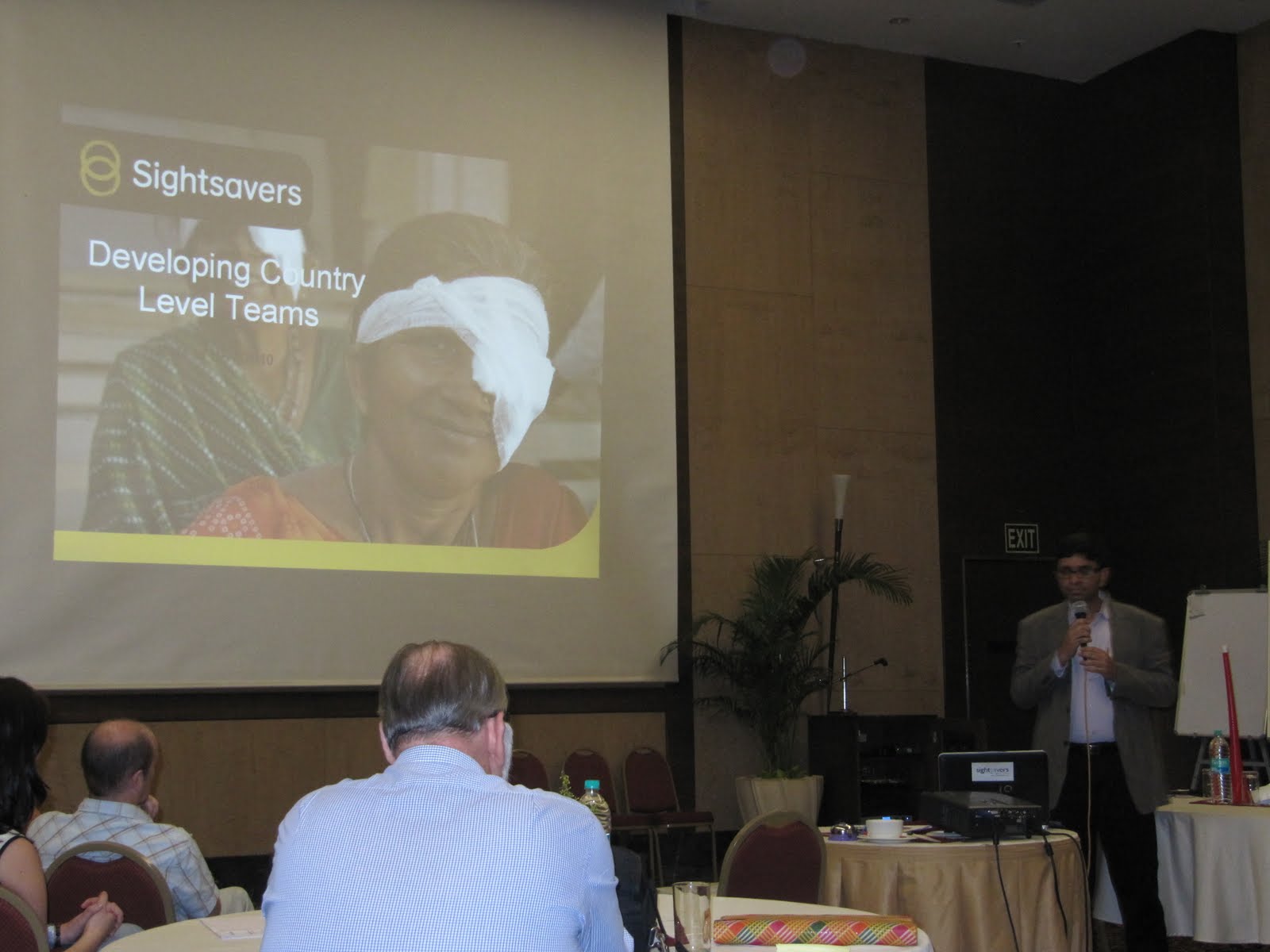

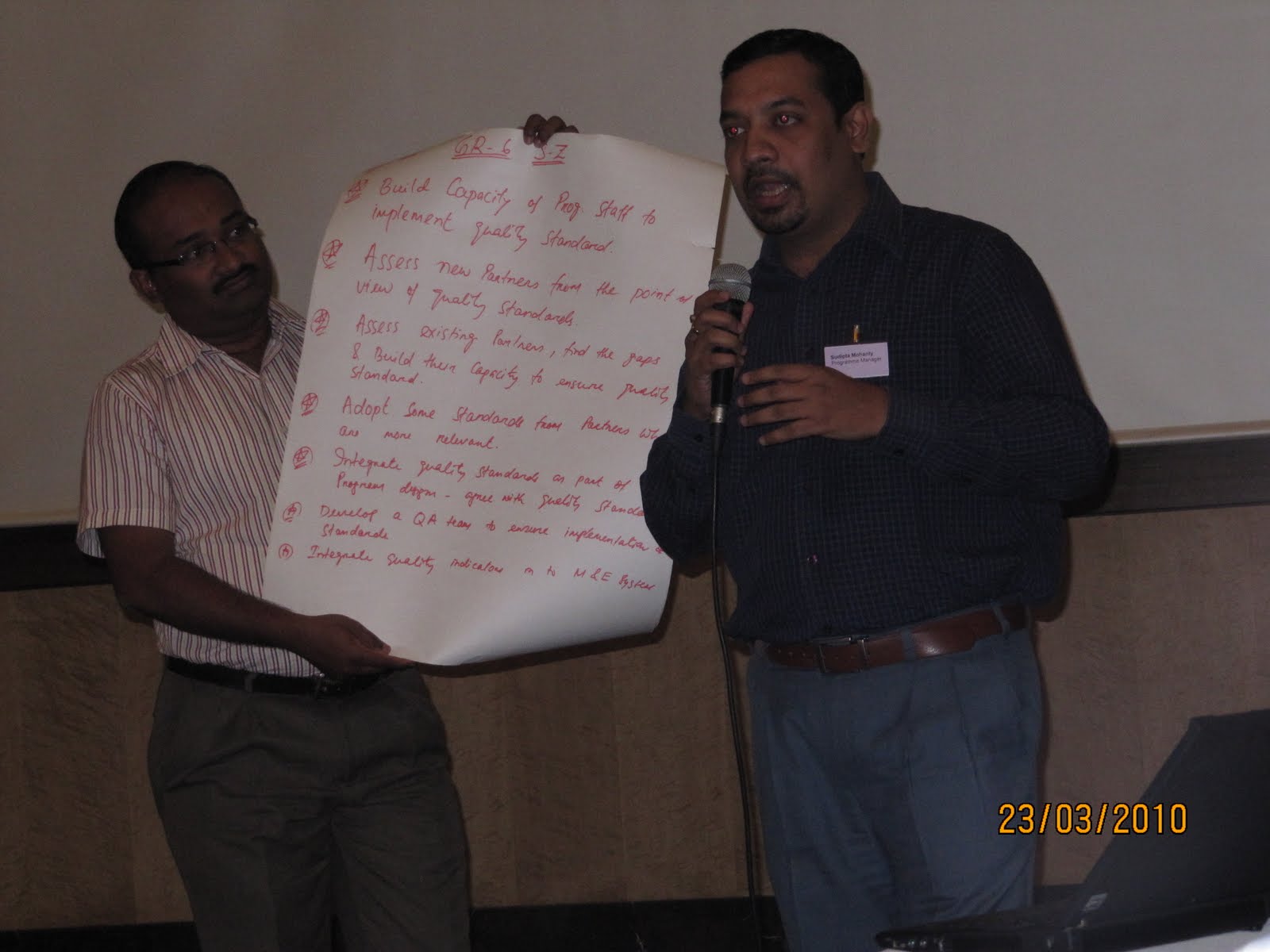
The Discourse, Groups Works and Discussions during Meeting

Dr Sandeep Kulsheshtra (India Regional HRD Manager)

Sabitra Kundu (Programme Manager, South India) and Sudipta Mohanty (Programme Manager, North India) during a presentation.

Left to Right: Joseph Musanje (Country Director, Gambia) and Prasannakumar (Area Director, North East India Area Office) doing a role play.

Posters Gallery

India Region Poster highlighting Strategic Themes

Appealing colors and content of South India Area Office.

Mumbai Eyecare Campaign Poster

The gender component illustrated in North India Area Poster was attractive.

The Barbeque Evening !
Award for best dancing : Abraham and Thoko

So who burned the dance floor !

Bhavana and Harshada on cloud 9 !

Revisiting memories !

Thursday, April 1, 2010

Social Inclusion Workshop for India and ECSA : 28th to 30th March, 2010

By Shweta Chooramani


The social inclusion workshop was primarily facilitated by Diane Mulligan, Praveen Kumar and Gertrude for three days at Hotel Retreat, Madh Island in Mumbai from 28th to 30th March,2010.

Day 1: 28th March, 2010


The day started with Diane's presentation on basic difference between human rights & equality. The session highlighted the fact that human rights respect the difference and empowers the person to take informed choices. It was emphasized that "Rights has to be given with dignity and not charity".

To let the participant grasp the concept of equality, she quoted an example of "Guaranteed Interview Scheme" in UK wherein all the applicants meeting the minimum eligibility criteria were called for an interview.


Following here presentation Ketan took a session on barriers faced by people with disability. There can be four types of barriers for disabled persons:

  1. Information and Communication
  2. Build Environment
  3. Insitutional
  4. Attitudes and Behaviour

To break these barrier time to time different types of models have been explored and applied rangin from traditional model where disabled persons were seen with pity to medical model where they their existence is valid only in presence of the certificate.

With time, social model evolved wherein the focus was on bringing the best out of the disabled person rather than their limitation. Then came the bio-psycho social model which was holistic as it envisages medical, pyschiatric and environmental needs of the person.

In second half of the session , Dr Sam Taraporewala shared his advocacy experience in financial access, print access, education of visually impaired and employement opportunities resepectively.


On left, Diane Mulligan from HH: Faciltator for workshop


Gertrude from West Africa Regional Office and Praveen Kumar from Noth East India Area Office: Facilitators


Ketan Kothari from South India Area Office: Took session on different models of disability and challenging attitudes and behaviours.


Day 2: 29th March, 2010

This day sessions were planned to identify gap in current approaches of CBR through group work. Discussions were driven around scalability, demonstration and twin trach approach. According to the twin track mainstreaming disability as well as initiating disabiltiy specific initiatives goes hand in hand.

George intorduced the guest speaker of the pre lunch session, Prasanna Pincha who is a member of national team leader on UNCRPD and also special rapporteur of National Human Rights Commission. His session revolved around the overview and analysis of UNCRPD.

Interesting disucussions surfaced up during this session about human rights and how the UNCRPD is being signed by a country. There are four generation of human rights. First generation human rights are those rights which can be realized immediately like civil and political rights. While, the second generation human rights are realized progressively by an individual like social, economic and cultural.


Guest speaker Prasanna Pincha welcomed by facilitators. He took a session on UNCRPD overview, its analysis, on how the UN convention can be used to enable PWDs to realize their rights.


Presentation by Prabhat Sinha, North West Area Office on WHO CBR matrix during group excercise.

India follows the dualist system of international law which signifies that an international commitment only becomes domestically operational when it is made part of a national legislation. India has both signed and ratified UNCRPD hence this international commitment requires that active steps be taken to make the rights available to persons with disabilities.

The flip sides of optional protocol as specified in UNCRPD was also discussed. According to this protocol a person with disability can seek guidance and justice from international committee if their voice is unheard in their country. While UK is the signatory of optional protocol, India has not signed it yet.

After the lunch session, participants were divided in group to work on linking the WHO CBR matrix with programmes supported by Sightsavers.

Day 3: 30th March, 2010

The concluding day area/region wise groups worked on stakeholder analysis for implementing UNCRPD.
Group work in India team for presentation on action plan within next 12 months on social inclusion.